Raymond Davey Raymond Davey
Science and History Author
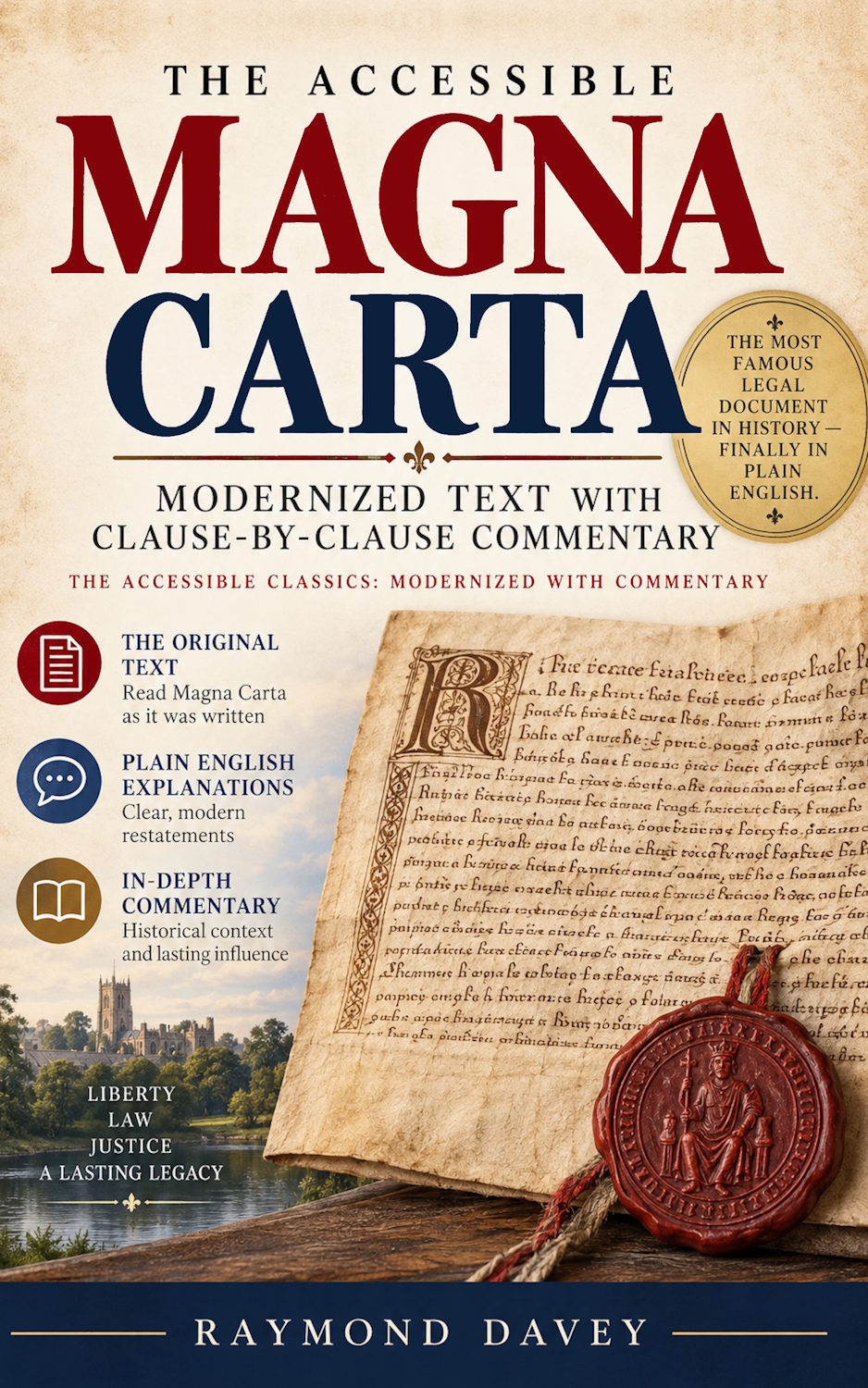
The Accessible Magna Carta
The most famous legal document in history. Finally in plain English.
Magna Carta is quoted more than it’s read. Everyone knows it as the birth of liberty and the rule of law, but almost no one has actually sat down with the text. Sixty-three dense medieval clauses about fish weirs, widows’ dowers, and knights’ relief payments.
The Accessible Magna Carta changes that.
This edition presents the complete 1215 charter using the classic public-domain Ernest F. Henderson translation, reorganized clause-by-clause into eight clear thematic parts: Liberty and Justice, Property and Inheritance, Taxation and Consent, Trade and Standards, the Church, Royal Officials, and more.
Every clause is followed by:
- The original translated text, so you can read Magna Carta as it was actually written
- A modern plain-English restatement, so the meaning is instantly clear
- In-depth commentary connecting each clause to its medieval context and its legacy in due process, habeas corpus, trial by jury, the U.S. Constitution, and modern constitutional law
Whether you’re a student of history, law, or political science, a homeschool educator, a constitutional law enthusiast, or simply someone who has always wanted to understand what Magna Carta actually says (rather than what it’s rumored to say), this book bridges the 800-year gap between Runnymede and today.
Perfect for readers of:
- Constitutional and legal history
- The Federalist Papers, the Bill of Rights, and founding-document explainer books
- Medieval and British history
- Homeschool and AP/college prep civics and history curricula
- Anyone who wants a clear, structured, non-academic guide to the roots of Western law
Includes a full historical preface, part-by-part introductory essays, and an afterword tracing Magna Carta’s influence from Runnymede to the modern rule of law.
Other Books in the Series
Foundational texts, rebuilt for modern readers
These books rebuild foundational texts in modern language while preserving their original structure and intent.
Instead of summaries, they provide direct access. Clear wording, structured commentary, and a focus on how the ideas actually function