Raymond Davey Raymond Davey
Science and History Author
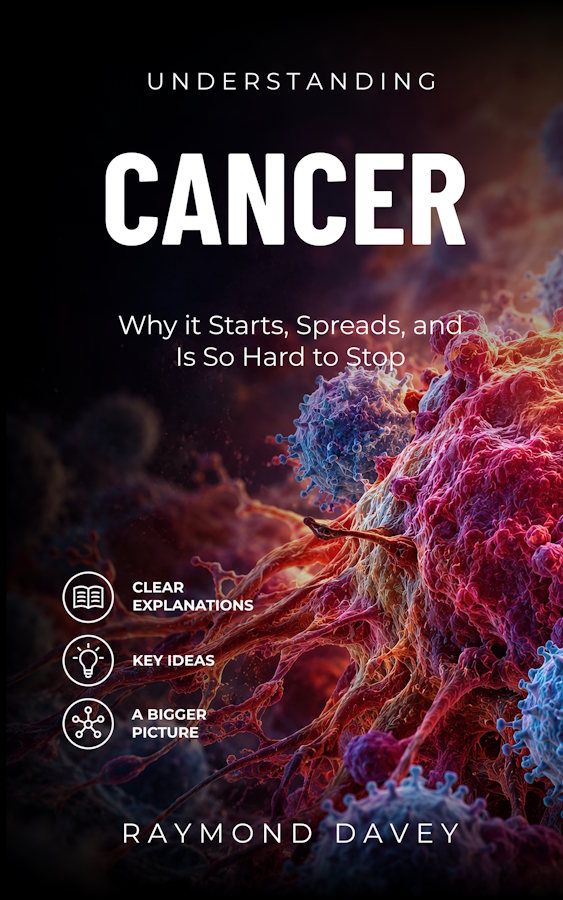
Understanding Cancer
Why it Starts, Spreads, and Is So Hard to Stop
Somewhere in a lab right now, cells taken from a woman who died in 1951 are still dividing. They are hers, and they are not. That strangeness is the doorway into one of the best explanations of cancer you’ll read outside a textbook.
Understanding Cancer: Why It Starts, Spreads, and Is So Hard to Stop takes readers from the story of Henrietta Lacks and the “immortal” HeLa cell line through the discoveries that rebuilt modern oncology: the chimney sweeps whose cancer first pointed to the environment, the chicken tumor that led to the discovery of oncogenes, the two-hit hypothesis that cracked the genetics of inherited cancer, the accidental birth of chemotherapy from a WWII chemical weapon, the checkpoint inhibitors that finally taught the immune system to see tumors again, and the reason the U.S. cancer mortality curve quietly bent downward after 1991.
Each chapter tackles a single, focused question. Why cancer is as old as multicellular life itself, why a cell that “looks” malignant doesn’t always behave that way, why some cancers vanish with a pill while others resist everything we throw at them. It builds a clear, connected picture of what cancer actually is: not an invader, but a breakdown in the cooperation that makes a body possible.
Written in plain language but grounded in real research (Hanahan and Weinberg’s hallmarks of cancer, Knudson’s retinoblastoma studies, Rous’s sarcoma virus, the discovery of BCR-ABL and Gleevec, Hanahan/Weinberg, Doll and Hill’s smoking studies, and more), this book is for curious general readers, not medical students (no prior biology background required)
You’ll come away understanding:
- Why cancer isn’t “one disease” but a family of related failures with a shared logic
- How oncogenes and tumor suppressor genes work, and how each causes cancer differently
- Why some cancers are curable with a single pill, and others resist everything
- How chemotherapy, targeted therapy, immunotherapy, and screening each fit into the bigger picture
- Why screening isn’t always the unambiguous good it’s assumed to be
- What actually caused the decades-long decline in cancer death rates
If you loved The Emperor of All Maladies, The Immortal Life of Henrietta Lacks, The Gene, or The Body, or if you enjoy accessible science writing in the style of Bill Bryson, Ed Yong, or Mary Roach, this book was written for you.
Part of the Understanding series. Books built to leave you with ideas sturdy enough to think with, on subjects too big to master in an afternoon but too important to leave a mystery.
Other Books in the Series
Difficult subjects, properly explained
The Understanding series explores the ideas, discoveries and events that are fascinating precisely because they are difficult to understand.
Each book takes one subject and builds it from the ground up, explaining the ideas that matter and showing how they fit together. No specialist knowledge is assumed, but the difficult parts aren’t avoided.
The aim is simple: not just to know more about the subject, but to come away genuinely understanding it.