Raymond Davey Raymond Davey
Science and History Author
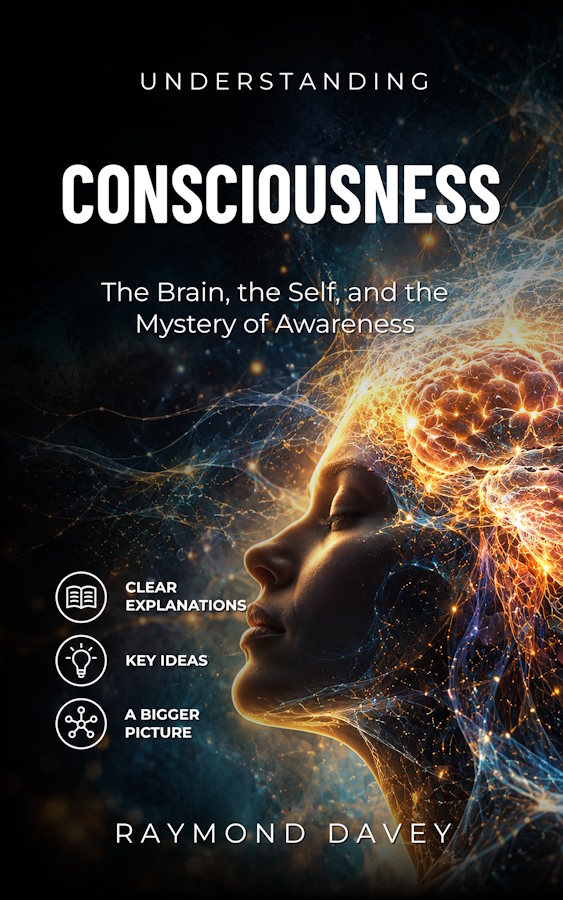
Understanding Consciousness
The Brain, the Self, and the Mystery of Awareness
What if the most obvious fact about your life is also science’s biggest unsolved mystery?
Right now, you are reading these words. Yet no one can yet explain how three pounds of soft, wet tissue produces the sight of red, the taste of coffee, or the feeling of being someone at all.
Understanding Consciousness is a clear, story-driven guide to the science and philosophy of awareness, written for curious readers with no background required. Starting in an operating room where a surgeon’s electrode makes a patient smell burnt toast, it walks you through the field’s most important ideas, chapter by chapter, and shows you where experts agree, where they don’t, and why.
Inside, you’ll discover:
- The hard problem of consciousness and why it has divided scientists and philosophers for decades
- Famous thought experiments (philosophical zombies, Mary’s Room, and “What is it like to be a bat?”) explained simply
- How neuroscientists hunt for the neural correlates of consciousness, and what the latest head-to-head experiments on rival theories found
- Global Workspace Theory vs. Integrated Information Theory, without the jargon
- What split-brain patients, rubber-hand illusions, and the invisible gorilla reveal about the self and attention
- Whether free will survives the famous Libet experiments
- Why your brain’s predictive processing means perception is a “controlled hallucination”
- The case for illusionism: the provocative claim that consciousness is not what it seems
- How psychedelics, anesthesia, dreams, and meditation map the landscape of altered states
- Patients diagnosed as unresponsive who turned out to be aware, and what it means for medicine
- Whether animals, insects, octopuses, and AI could have an inner life
Honest, not hype. Where scientists still disagree, this book says so instead of picking a side and calling it consensus. You’ll finish with ideas sturdy enough to think with and curious enough to send you further.
Perfect for readers of popular neuroscience, philosophy of mind, psychology, cognitive science, and big-question science writing, and for anyone wondering about free will, the nature of the self, or whether artificial intelligence could ever truly feel.
Ideal for: curious beginners, students, meditators, psychology and philosophy fans, and anyone who has stared at the ceiling and wondered why there is something it is like to be them.
Other Books in the Series
Difficult subjects, properly explained
The Understanding series explores the ideas, discoveries and events that are fascinating precisely because they are difficult to understand.
Each book takes one subject and builds it from the ground up, explaining the ideas that matter and showing how they fit together. No specialist knowledge is assumed, but the difficult parts aren’t avoided.
The aim is simple: not just to know more about the subject, but to come away genuinely understanding it.