Raymond Davey Raymond Davey
Science and History Author

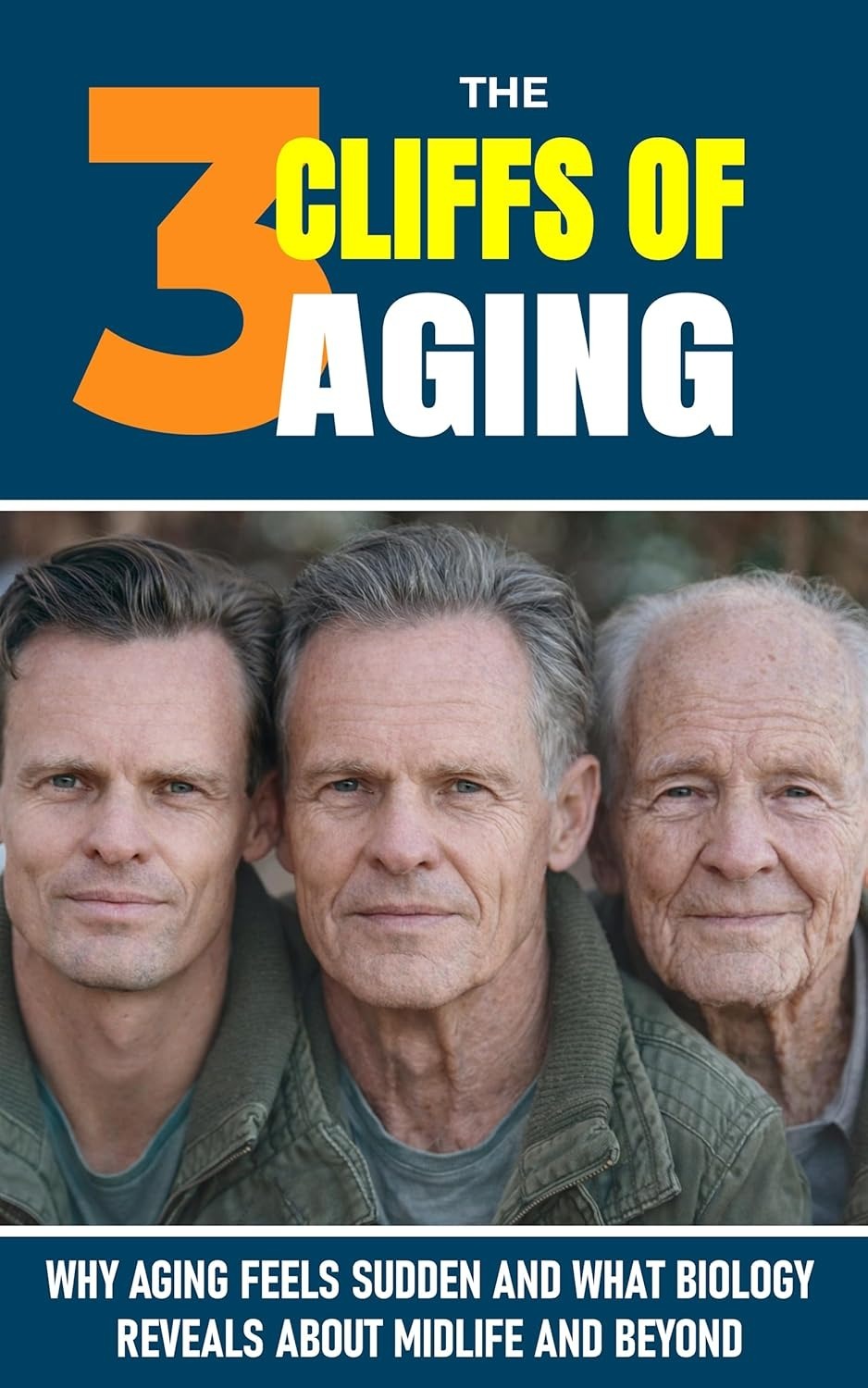
The Three Cliffs of Aging
Aging Isn’t Gradual. It Happens in Cliffs.
Most of us are taught to imagine aging as a slow, predictable decline. A gentle slope we can manage with discipline, exercise, and good habits.
But for many people, especially those who have taken care of themselves, aging doesn’t feel gradual at all.
Recovery suddenly takes longer.
Performance drops abruptly.
Focus, coordination, and resilience become less reliable. Sometimes within a surprisingly short window.
This book explains why.
What The Three Cliffs of Aging Is About
The Three Cliffs of Aging presents a biological framework for understanding why human aging unfolds through sudden transitions rather than smooth decline.
Drawing on research from:
aging biology
neuroscience
physiology
systems science
longitudinal human and animal studies
the book shows that thresholds govern aging. Points at which complex systems can no longer compensate and must reorganize.
These transitions appear consistently across populations and cultures and tend to cluster in three major phases:
a first shift in recovery and resilience
a second in performance, coordination, and integration
a third affecting cognitive coherence and identity
These are not lifestyle failures.
They are design limits of complex biological systems.
A Different Way to Think About Aging
Aging is not a problem to be solved.
It is not a failure of effort or discipline.
And it is not a gentle slope.
It is a series of biological phase transitions.
The Three Cliffs of Aging doesn’t tell you how to avoid them.
It helps you understand what they are and why that understanding matters.
Other Books in the Series
How life works, from the inside out
These books explore the systems that make life possible. Cells, development, immunity, energy, and the underlying processes that sustain every living organism.
Each one reconstructs complex biology as a clear, continuous narrative, focusing on how it works rather than just what it is. The aim is not simplification, but understanding.