Raymond Davey Raymond Davey
Science and History Author

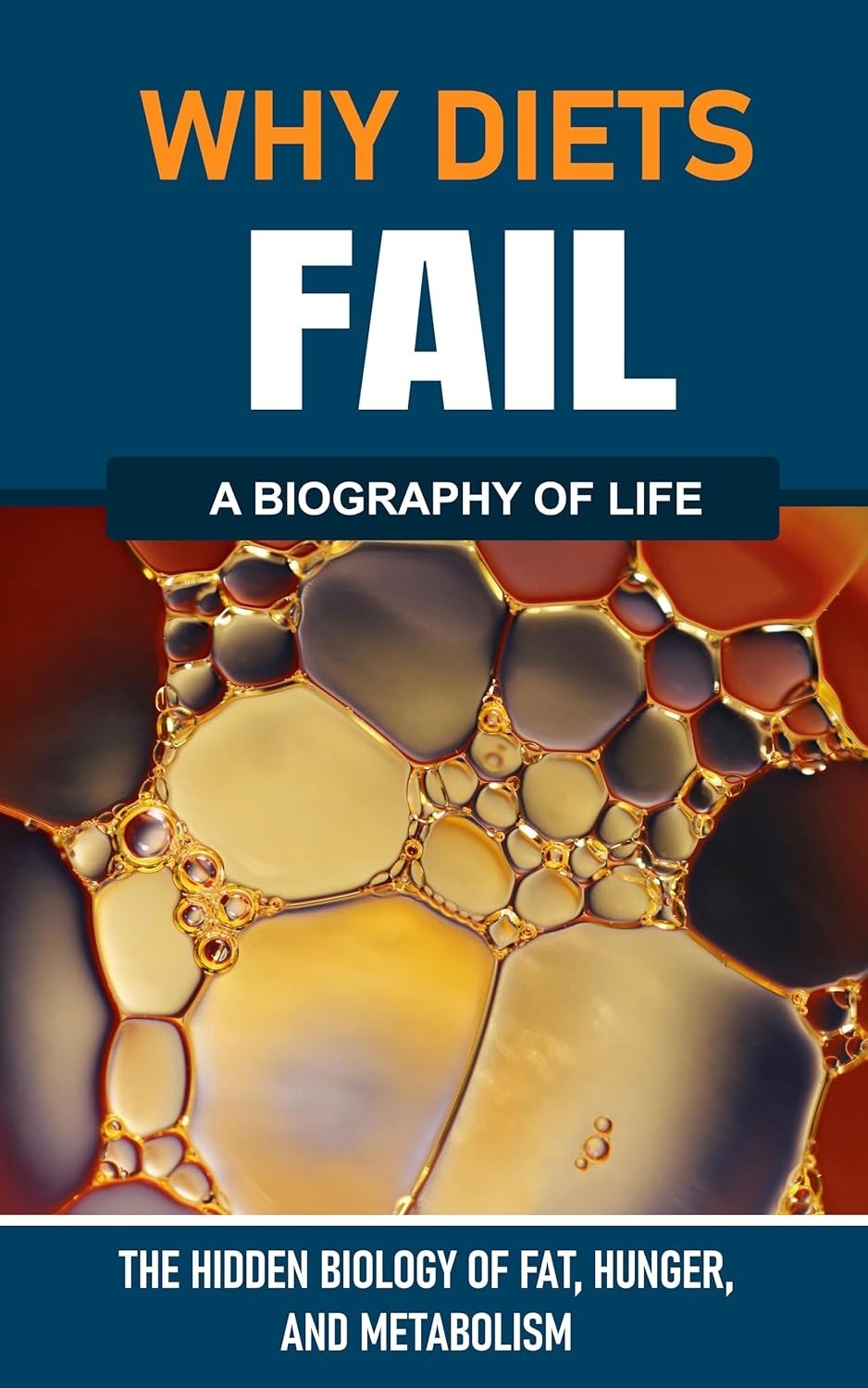
Why Diets Fail
Most people are taught that weight loss is simple.
Eat less. Move more. Stay consistent.
And for a while, it works.
Then something changes.
Hunger becomes harder to ignore. Energy drops. Progress slows, stalls, or reverses.
For many people, the weight comes back. Often faster than it came off.
This book explains why.
What Why Diets Fail Is About
Why Diets Fail presents a biological framework for understanding fat regulation as a system, not a calculation.
Drawing on research from:
- metabolism and energy expenditure
- endocrinology (leptin, insulin, ghrelin)
- neuroscience and reward signaling
- evolutionary biology
- human and animal studies of weight loss and regain
The book shows that body weight is actively regulated through overlapping feedback systems.
These systems respond to weight loss as a threat, not a success.
They adjust:
- hunger signals
- metabolic rate
- energy allocation
- food reward
- stress and recovery responses
to restore lost fat.
What This Book Is Not
This is not a diet book.
It does not provide meal plans, food rules, or weight loss programs.
It does not promise fast results or lasting fat loss.
It does not offer hacks, shortcuts, or prescriptions.
Instead, it explains the biology behind why those approaches so often fail.
What This Book Shows
Across chapters, a consistent pattern emerges:
- metabolism is not fixed. It adapts
- hunger is not stable. It intensifies under restriction
- fat is not passive. It is regulated
- exercise does not operate as simple calorie burn
- weight regain is not unusual. It is biologically expected
What appears to be failure is often the system working as designed.
Other Books in the Series
How life works, from the inside out
These books explore the systems that make life possible. Cells, development, immunity, energy, and the underlying processes that sustain every living organism.
Each one reconstructs complex biology as a clear, continuous narrative, focusing on how it works rather than just what it is. The aim is not simplification, but understanding.