Raymond Davey Raymond Davey
Science and History Author
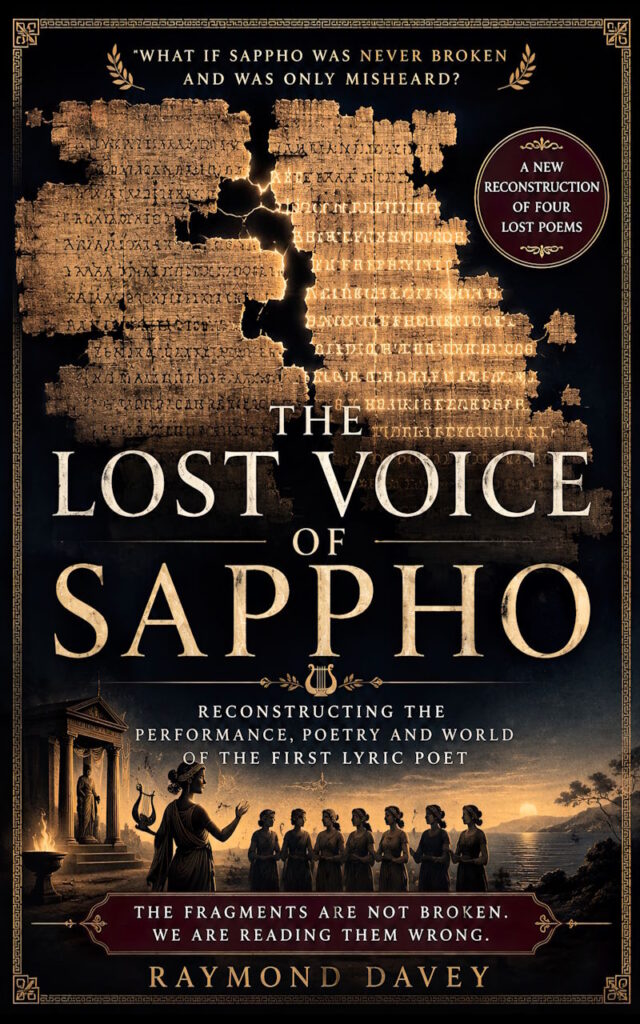
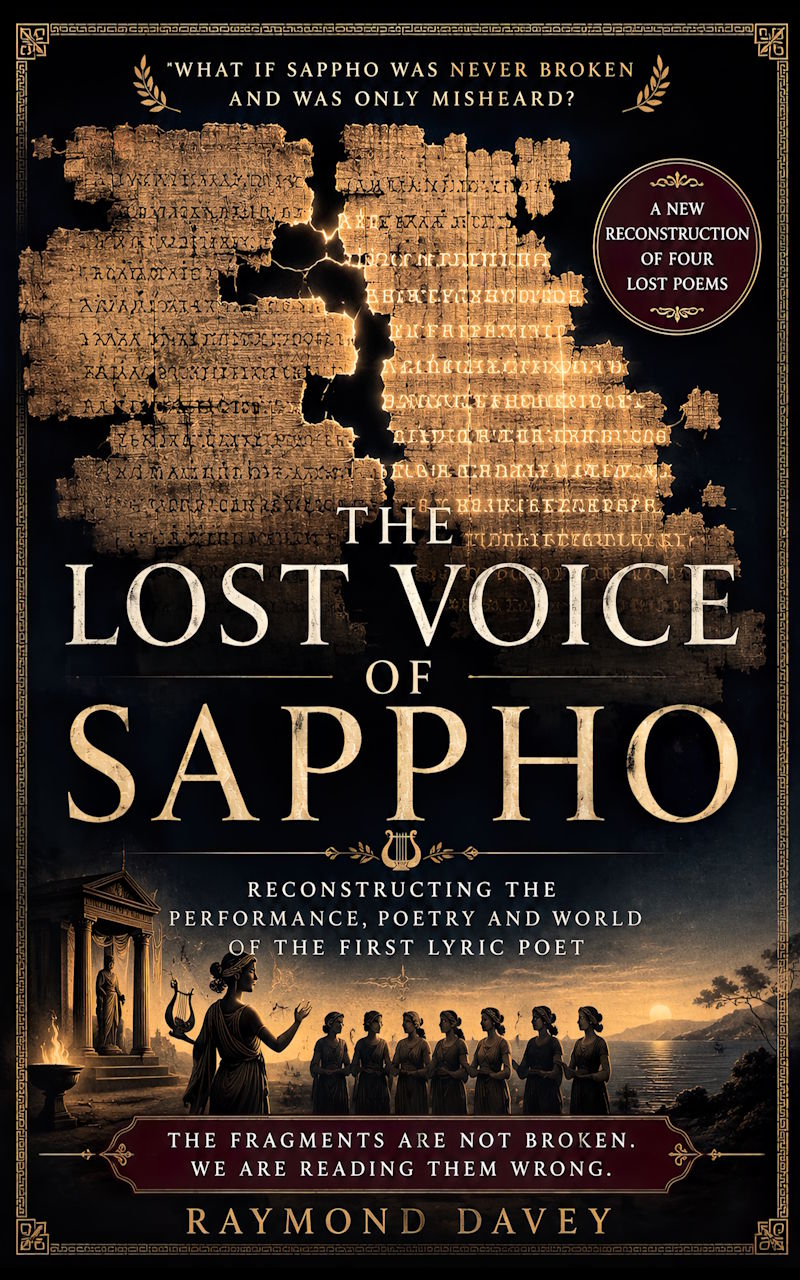
The Lost Voice of Sappho
For two thousand years, readers have been told that Sappho survives only in broken pieces. Beautiful ruins, intimate confessions cut short by time.
This book argues that the fragments were never broken. The performance around them was.
Drawing on papyrus discoveries, ancient quotations, and what we can reconstruct of the lost nine-book Alexandrian edition, The Lost Voice of Sappho doesn’t try to recover the missing words of her poems. It reconstructs the system that once made them whole: the lyre music, the choral weddings, the female social networks of archaic Lesbos, and the invocations that were meant to summon a goddess rather than simply describe one.
This is not another translation of Sappho. It’s a different kind of book.
Part literary detective work, part cultural history. Built around the question scholars keep avoiding: not what did Sappho write, but how did her poetry actually work?
Inside, you’ll find:
- How the Library of Alexandria’s lost edition shaped (and distorted) nearly everything we think we know about Sappho
- Why the famous “I” in her poems may never have been autobiographical
- How desire functions in her poetry as an external force rather than a private feeling, and what that means for reading Fragment 31
- The case for treating Aphrodite as an operative presence within the poems, not a literary metaphor
- How centuries of editors and translators quietly turned explicit erotic language into “spiritual friendship”
- Four disciplined reconstructions (an invocation hymn, a desire poem, a choral prayer, a wedding song), each clearly marked for what is preserved text, plausible inference, or editorial bridging
Readers of Anne Carson’s If Not, Winter, Natalie Haynes’s Pandora’s Jar, and Bettany Hughes’s Venus and Aphrodite will recognize the same fragments, read through an entirely different lens.
Written for general readers, classics enthusiasts, students of ancient Greek literature, and anyone who has found Sappho’s surviving lines beautiful but bewildering, The Lost Voice of Sappho offers a rigorous, accessible way to hear one of history’s most famous poets the way her original audience actually heard her.
Other Books in the Series
Recovering what survives in fragments
Some of the most important events, systems, and texts do not survive directly. They exist in fragments. Quoted, distorted, or preserved by those who had reason to reshape them.
These books reconstruct those worlds by working from the surviving evidence, separating what is observed, what is inferred, and what remains uncertain. The result is not retelling, but recovery.